Ratchet and Clank 2: Locked and Loaded – Ratcheting Up

FUN FACT: Although Angela Cross is not stated to be a lombax, she clearly looks like a very similar species to Ratchet.This has caused all sorts of confusion in later games due to Ratchet apparently being the only lombax, and Angela barely being referenced. (Image: R&C Wiki)

Ratchet and Clank (the original, not the less than stellar remake) was a fantastic game, but certainly not without its flaws. With only a year until the sequel had to release, Insomniac had to iron out the kinks with their new franchise under extreme time pressure. And they did just that.

In the vein of both its predecessor and other mascot platformers, Ratchet and Clank 2: Locked and Loaded has a pretty simple story; Ratchet and Clank have been heralded as heroes for saving the world from Chairman Drek, but coasting on their newfound fame has become boring to the duo, especially Ratchet. Whilst watching the two on a TV documentary, the eccentric Abercombie Fizzwidget summons the duo to the Bogon Galaxy to recover a stolen experiment. With some twists and turns like its predecessor, it’s still very much an engaging story.

Although the first game was primarily a platformer with guns, the second game features a more hearty mix of both styles of gameplay. It leans more towards shooting in some scenarios, but the combat setups become so difficult later on that battles almost feel like puzzles. And the weapons this time are fantastic, with hits like the Bouncer, Lava Gun, and Plasma Coil. There are a few duds as well like the Clank Zapper, and incredibly situational ones like the Spiderbot Glove. All of these weapons can be upgraded, which is a first for the series, and an absolute game changer. A few weapons return from the first game, but cannot be upgraded, making them immediately less useful than their newer counterparts.

FUN FACT: The aggressive AI of the Y.E.T.I. enemies was not just hated by players, but Insomniac themselves. Snowbeast Awards are now given to the most annoying mechanic from each Ratchet and Clank game. (Image: R&C Wiki)

Throughout his adventures, Ratchet is faced with the Thief and their hired muscle, Thugs-4-Less. The dynamic between the villain and their goons makes for a large part of the game’s comic relief, and the humour is as good as it was in the first game, if not better. A lot of anti-consumerist satire makes its way into the game at the expense of Fizzwidget’s Megacorp, which is a huge organisation that is effectively an interplanetary equivalent to Amazon. Few characters return from the previous adventure, at least not in meaningful roles, though this makes sense due to the fact that the duo are in an entirely new galaxy.

Where Ratchet and Clank 2 really shines is the sheer amount of variety in all of its content. Arena battles make their debut here, giving Ratchet and Clank a series of tough combat setups. Unlike any game since, however, there are two different arenas, and three unique bosses to be fought as part of these challenges. In addition to this, hoverbike racing replaces hoverboard racing from the first game, and feels like a much more fulfilled concept. The races can be incredibly difficult and frustrating, but mastering them feels fantastic, not unlike the F-Zero games in that respect. Building on the jet fighter missions from the first game, there is now fully realised space combat as well. The duo also occasionally find themselves on spherical planets, and this was four years before Super Mario Galaxy popularised that concept.

It’s clear how hard Insomniac Games worked to make Ratchet and Clank 2 happen; sadly, this development did involve an obscene amount of crunch, especially considering the game was developed in just 10 months. So much content ended up on the cutting room floor, but employees at Insomniac found a way to incorporate much of this; the Insomniac Museum. I’ve never actually been able to visit the Insomniac Museum due to the fact that it’s only open when the PS2’s clock strikes 3 am exactly, and I can’t be bothered changing it in the options setting. That being said, the stuff in there is incredible, and shows just how much effort went into this fantastic game. There’s even some cut content from the first game in there.

FUN FACT: The Insomniac Museum is found on Planet Burbank, named after the Californian city which is home to Insomniac’s office to this day. (Image: R&C Wiki)

The only major weakness of this sequel is that I think it the two weakest planets are back to back. Gorn is a space combat level that is incredibly difficult, especially in the context of aiming for 100% completion. However, Snivelak makes Gorn look like a leisurely stroll on Pokitaru. It’s home to some of the most difficult fights in the game, with strong enemies and very tight spaces that leave little room for manoeuvre. It’s the boss battle that drags this level down, however. Not only is it largely a turret section, which are never the best, but the Thugs-4-Less leader’s mech has an obscene amount of health, so the fight just drags on. Even these dodgy planets are still enjoyable though, as the challenge doesn’t really feel cheap, just like a really strong test of what you’ve learned this far.

If Shrek 2 is the perfect sequel to an animated film, Ratchet and Clank 2 is its video game equivalent. It takes all of the best concepts from the original game and expands upon them brilliantly. It is singlehandedly the most important entry of the series in that many of its new mechanics went on to become series staples, especially levelling up weapons and the arena stages. With the Ratchet and Clank series celebrating its 20th anniversary, it’s amazing how much of the series’ history was shaped by one game.

Sonic 2: A New True Blue

A promotional poster for the film.
FUN FACT: This poster is based on the box art for Sonic the Hedgehog 2 on the Mega Drive. (Image: Paramount)

The first Sonic the Hedgehog film proved to be a surprise pre-pandemic hit. After the initial disaster of a trailer, the new design for Sonic and his light-hearted adventure made for an absolute delight that knew how goofy it was and rolled with it.

Fortunately, the sequel builds on the strengths of its predecessor. In addition, less focus is placed on the human characters, who were easily the weakest part of the first film. We get to see the animal characters interact a lot, which gives the audience time to get used to them. It’s amazing to see the iconic trio on the big screen, and they all look so great.

The story of Sonic 2 is pretty simple; whilst huntingfor Sonic, Knuckles stumbles upon Dr Eggman. With the blue blur being their mutual enemy, the two of them team up to bring him down. Aware of Knuckles’ manhunt (hedgehoghunt?), Tails tracks Sonic down to warn him that they need to find the Master Emerald. In other words, it’s a loose adaptation of Sonic 3 – the game, not the upcoming film. Some elements, like the introduction of Tails, are plucked from Sonic 2 instead.

Sonic, Tails and Knuckles.
FUN FACT: Since Sonic Heroes, the trio of Sonic, Tails and Knuckles is often called Team Sonic. (Images: Paramount)

In my brief review of the first film, I said that the groundwork had been laid for Knuckles to be introduced as a villain at first. Of course, like in the source material, Eggman was only using Knuckles. It is then that the echidna realises Sonic is not his enemy. After the amazing snowboard chase scene, Sonic and Knuckles briefly bonded over the fact that they were orphaned on opposite sides of a war between their ancestors and guardians respectively. It was nice to see the two of them share common ground here, and made it so the two teaming up later on didn’t feel forced.

Although Jim Carrey delivers another exceptional performance as Dr Eggman, for me it was Knuckles who was the star of the show. Idris Elba brings a stoicism to the character that has been lacking in the games for over a decade at this point, where he has been reduced to comic relief. Elba’s version of Knuckles is a noble warrior, but still has great comedic moments, particularly at the end of the film.

There are plenty of nods to the games in Sonic 2, which keen eyed fans will love; Eggman’s Classic design makes a brief appearance, Splash Hill from the less than stellar Sonic 4 is shown on a truck, and Tom’s ringtone is the classic Green Hill Zone theme. There’s a lot to love. More music from the games would have been nice though, a criticism I also had about the first film.

Sonic standing on the Tornado aeroplane.
FUN FACT: The aeroplane seen numerous times in the film is the Tornado, Sonic’s plane from the games which he later gives to Tails. (Image: Paramount)

As with the first film, the weakest part of this one would be the human characters that aren’t named Eggman. G.U.N. is a welcome addition to the film universe, but their introduction featured a drawn out plot in which the sister from the first film was getting married. Nobody cares. Some scenes were entertaining, but overall I’d say the film would be no worse without them.

Another gripe that carries over from the first film is the characterisation of Sonic. He is quite literally called a kid, and very much acts like one. He’s still cocky, which is good, but a little bit too juvenile to feel like a faithful adaptation of the hedgehog from the games. I touched on this in my last review, saying I hope that they let him grow into the version we know and love from the games, but that didn’t quite happen here. Hopefully, they’ll take this direction with him in the future. That being said, Tails has a great character arc about facing his fears – even if he did get knocked out and therefore did nothing for a solid 20 minutes – and Knuckles is just a delight, making Sonic the clear weak link of the trio.

For the sequel to a film I’d watched in 4DX, I decided to make the same choice here. And yes, it was as enjoyable as the first time. The more action-oriented parts of the film like the snowboarding section and the final battle were amazing, with the seats shaking. Eggman also spat out drinks a number of times, and they used a water effect which added to the hilarity of the scene.

A very big spoiler warning is warranted here, because it wouldn’t be a review of Sonic 2 without discussing the mid-credits scene. I’ll mention this after the next image.

A picture I took of the gorgeous credits sequence.
FUN FACT: Sonic has snowboarded in mainline games a number of times, including in Sonic 3, Sonic Adventure, and Sonic ’06. (Image: Paramount)

The initial credits are gorgeous, showcasing some amazing pixel art. After this segment, the mid-credit scene begins; G.U.N. agents discuss a secret government project from 50 years ago; G.U.N. being introduced as a background antagonist was already a huge hint towards the direction they were going to take the next film, but this conversation confirmed my suspicions. They then show the project, and it’s one from the same game in which G.U.N. debuted. Sonic Adventure 2 will be getting adapted for the third film, and I couldn’t be more hyped. The crowd in the cinema were audibly excited, much like I was for Tails in the last film.

With the Knuckles TV series and a third film on their way, now is a great time to be a Sonic fan. Sonic Frontiers is also coming up, so it’s clear that SEGA is putting all their rings in Sonic’s basket.

Ranking Mario Kart Wii’s Original Tracks

FUN FACT: Mario Kart Wii sold 37.38 million copies worldwide, making it the best-selling game on the console other than Wii Sports.

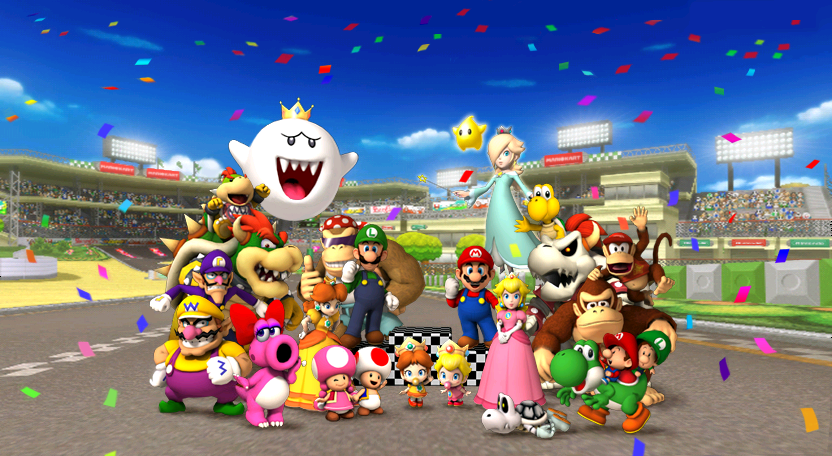
Looking back at Mario Kart Wii, it’s apparent that this Mario Kart more than others leaned into the chaotic nature the franchise had a reputation for; the physics were bouncier, the items were crazier (Thunderclouds and more frequent Blue Shells made for some maddening moments), and the courses enabled all kinds of hectic races.

With what I think is one of the best original track selections in the series, it’s time to take a look at which ones I think are the best of the best.

16. Grumble Volcano: Though it may be my least favourite Mario Kart Wii track, I don’t think Grumble Volcano is all that bad. I’m not too keen on the volcano theme because I think it’s a little dull, and the layout of the track just doesn’t interest me all that much. The moving platforms after the cave are cool though, as is the fact that the track slowly crumbles. It makes you think it should be called Crumble Volcano instead.

15. Moo Moo Meadows: This is a really nice track, but a little bit plain. It shares a theme with Moo Moo Farm from Mario Kart 64, and doesn’t do too much different from it. There’s a windmill now, which is kinda neat, but that’s it really. The track is still fun to drive on and using Mushrooms to cut out a lot of the grassy areas can be fun for sure.

14. Luigi Circuit: There’s nothing wrong with Luigi Circuit at all, it’s a very simple track that’s completed very quickly. As the first track in the Mushroom Cup it basically serves as a tutorial on how to play the game, and the simplicity is a bit of a by-product of that. That being said, it’s still a fun layout that’s more interesting than the typical first course figure 8s, which is certainly to its credit.

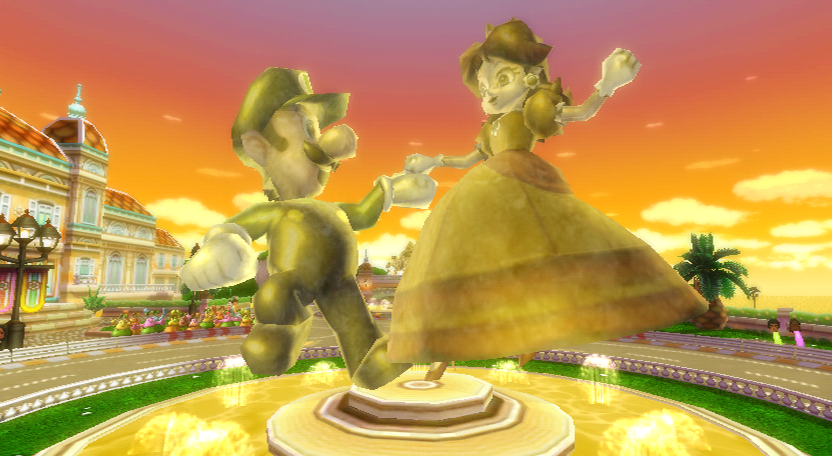
Sunset is the best time of day, we need more sunset Mario Kart tracks.

13. Daisy Circuit: As far as the circuit tracks go, Daisy Circuit is pretty unique. It’s set in a quaint coastal town at sunset which is really nice, and has the fun staircase shortcut and the little side road in the last part of the map. It’s not the most memorable track out there, but from a roster this solid that is nothing to scoff at. I do wish Daisy got more tracks that harkened back to her debut in Super Mario Land, however.

12. Dry Dry Ruins: Similar to Moo Moo Meadows, Dry Dry Ruins has a lot in common with a previous track; this time, Dry Dry Desert from Mario Kart: Double Dash. Desert tracks never interest me too much, but I do like how this one plays, with the sand pit in the middle of the ruins and the Swoopers flying around at the start of the ruins. There’s a lot of shortcut potential here that makes this track a great one for comebacks and upsets, which is a type of track that’s necessary in every instalment.

11. Toad Factory: What I like about this track is that its theme is something we’ve not really seen in Mario Kart either before or since the Wii instalment. The conveyor belts are a fun little gimmick that doesn’t feel too intrusive, and I especially like the long turn with the two conveyor belts near the end of the track. The mud just before the finish line can be a little tricky to navigate without a boost, but fortunately there are plenty of boost panels to make it easier to traverse without a Mushroom. The music’s also great here as well.

10. Mario Circuit: Mario Circuit tracks are usually fun, if a little predictable as most are set close to Peach’s Castle. This one is a nice one to drive on though, with the more city-like design compared to the previous Mario Circuit tracks. The area with the Chain Chomp always manages to get hectic, especially with the boost ramp to the right letting some people cut across that area. It’s one of my favourite Mario Circuits, which says something considering they’re mostly pretty solid tracks. It’s also the first track that I played in this game, so it has some extra nostalgia points.

Moonview Highway | Wiki | Mario Kart Amino
This track always terrified me when I was younger.

9. Moonview Highway: When I was a kid, this track was the absolute bane of my existence. Perilous cars are around every corner of Moonview Highway, included the dreaded Bob-omb that explode when you hit them. The older I get the more I appreciate this track though, because there’s a learning curve to it and when you know how to weave around the traffic, it makes for some really high stakes races where you’re only a crash away from losing. And the city at night aesthetic is gorgeous, it makes the track stand out nicely.

8. Bowser’s Castle: I’m never normally a huge fan of the Bowser’s Castle tracks, but the one in Mario Kart Wii is amongst my favourites. The bridge over lava into a twisty corridor is a great way to set the scene, and the half-pipe section with the giant Bowser shooting fireballs at you is really cool too. The Giant Bowser was basically a clone of the one in Double Dash’s Bowser Castle though, so it feels a bit unoriginal.

7. DK’s Snowboard Cross: Also known as DK Summit, this track is a mad dash around a bunch of ski slopes and bumps that always makes for a chaotic race. There’s some surprisingly easy shortcuts to shave a bunch of seconds off your time at the end of the lap, and the skiing Shy Guys are both hilarious and some interesting obstacles. Between this and DK Pass in Mario Kart DS, I don’t quite know why there was such an interest in making snow-themed levels for Donkey Kong, but it’s a great track that I’d love to see return in a later Mario Kart.

6. Wario’s Gold Mine: Another great track from the Flower Cup, Wario’s Gold Mine is another fun theme that lends itself really well to a racecourse design. Driving on the minecart track is fun, though crashing into the minecarts can lead to some very costly mistakes, as it takes a while to recover. I always try and take the little side road near the end of the track, but the fact that the minecarts take the same route can make it a little risky at times. This risk was removed in Mario Kart 8 due to the anti-gravity mechanic make it so the minecarts boosted you rather than stopping you in your tracks. That makes it much easier, but still a fun time for sure.

5. Rainbow Road: This is my personal favourite of the Rainbow Road tracks. Not only is the road visually gorgeous, but this track can be brutal when it wants to be. There’s a lot of different routes that reconnect which is always fun, and the roundabout-type turns in the middle can be jumped over if you have a mushroom, which is a dangerous shortcut but can be very rewarding. It definitely feels like the final gauntlet and its difficulty makes it memorable in a way that Mario Kart 8’s Rainbow Road just lacks.

4. Koopa Cape: Koopa Troopa (alongside its undead counterpart, Dry Bones) is one of my favourite characters to play as in Mario Kart, and this is a track that does it justice. Not only are the sections with the moving water great to drive on because of the speed increase, but the already great music changes when you enter the pipe, which I think is the only example of dynamic music in the series until Mario Kart 7’s underwater sections. The pipe section is also fantastic because of the added peril of the spinning electric wheels, which can shrink you if you’re not careful. This is one of those tracks that lends itself to frantic races, which makes it all the more enjoyable.

3. Maple Treeway: The first thing you notice when playing Maple Treeway is how visually appealing it is. There’s a bunch of lovely autumnal colours, it just feels so quaint. And it’s a great track to drive on, especially if you can get onto the shortcut path at the beginning. Getting a Star from the piles of leaves that can drop items is a great feeling as well, especially when you’re in a position where you can’t get a Star. The part where you’re driving on the wooden road always feels risky when you cut corners too tight, but that just adds to the fun of it.

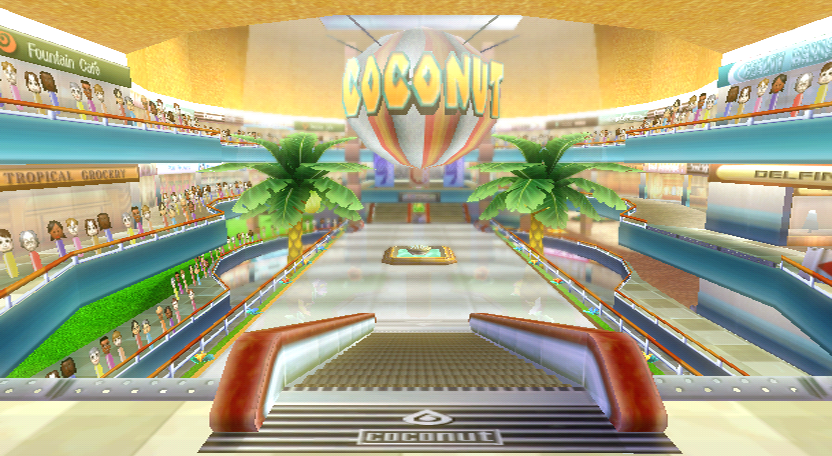
View of Coconut Mall in Mario Kart Wii.
Imagine if a bunch of people actually started driving go-karts around when you were just trying to shop.

2. Coconut Mall: Whenever I play Mario Kart Wii with friends, Coconut Mall is one of the first tracks that gets selected. Everybody always wants to pick this one early into a session, and for good reason. It’s a really fun concept that’s made into such a fun course design. It helps that the music is great too, and really fits the level. Everything about this track is Mario Kart Wii at its best is on display here, from the creativity to the mayhem to the driving feeling great, even when you’re going up an escalator the wrong way.

1. Mushroom Gorge: Without a doubt, Mushroom Gorge is the most memorable track from Mario Kart Wii. Everyone who’s played this game has memories of bouncing on the mushroom platforms and being thrown into the abyss by a poorly timed Red Shell or Lightning. This is the only track that my dad was able to beat me on when I used to play Mario Kart with him, and it’s something he still brings up to this day. It holds a special place in my heart for the nostalgia, but it’s also just a really solidly designed course with a brilliant soundtrack and the concept of bouncy mushrooms on a racecourse fits the Mario universe too well. Absolutely stellar track, and my personal favourite from this game.

Interestingly, all four tracks in my top four were chosen to reappear in Mario Kart 7. Nintendo must have realised just how great they were, as they very much are the cream of an excellent crop. Even the tracks I ranked lowest on this list make for good races, and I believe that this was a tremendous output of quality courses for just one game.

I hope to see more of these tracks get the HD treatment one day, as only 3 of these tracks were in Mario Kart 8 (with Wario’s Gold Mine only appearing as a DLC track that was then included in Deluxe).

New Pokémon Snap: Worth the Wait

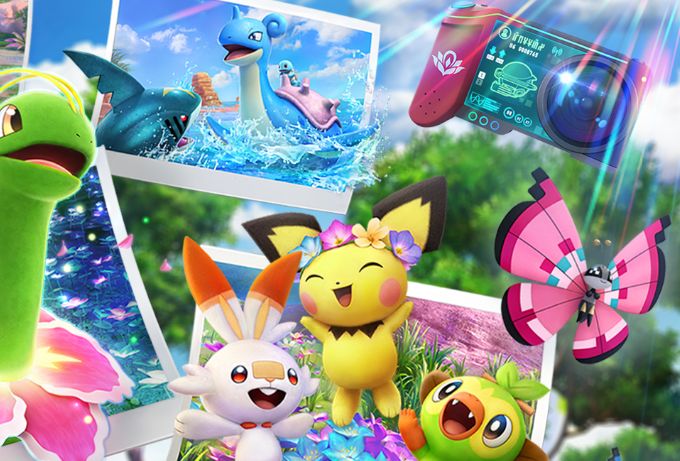
Here's The New Pokémon Snap Box Art | Cultured Vultures
FUN FACT: Although Grookey and Scorbunny both appear on the game’s front cover artwork, their fellow Galarian starter, Sobble, is relegated to the back cover. Poor Sobble.

Sequels that come many years after the original can vary wildly in quality, and this was something in the back of my mind when New Pokémon Snap was announced to be getting released at the end of April. Having played the game and exhausted the opportunities, I can safely say that any concerns I had were put to rest.

Thankfully, this sequel didn’t feel the need to reinvent the wheel; you’re still a young photographer tasked by a professor to go and take pictures of wild Pokémon in your machine that sticks to set paths. Along the way, you unlock items that you can throw to/at Pokémon to see how they react. At its core, this game is as faithful to the original as it could possibly be, and that works in its favour.

It would be a crime to talk about this game without mentioning how gorgeous it is. In just about every aspect, New Pokémon Snap blows Sword and Shield’s mediocre graphics out of the water. Textures are crisp, the locations are stunning and the Pokémon are so lively. There’s so many random interactions I’d never expect to see, like Scorbunny sleeping on Torterra or Torchic and Hippowdon befriending each other at a desert oasis. Every Pokémon oozes personality in this game, which makes taking pictures of them even more fun.

Where this game differs from its predecessor is the introduction of a slightly more involved story. Sure, the core is the same, but you make new friends and attempt to discover the mystery of the Illumina Pokémon as you travel around the Lental Region. The cutscenes that come with this story are stunning, and frankly the best a Pokémon game has ever looked.

New Pokémon Snap length explained: How long is New Pokémon Snap? •  Eurogamer.net

What I really like about New Pokémon Snap is that there’s so many secrets to be found, just like the original game. I was worried it’d be more handholdy, but it’s really not; there’s a scan function that helps draw your attention to a couple of things, but there are so many hidden paths and features that the scan only really provides slight hints for. You’ve got to figure things out on your own, and I love this. Pokémon games really should put more trust in their players because this game shows how well it can pay off.

An addition to the Snap formula that I really liked is that quests have been brought into the fold. Getting specific poses of Pokémon can yield rewards that allow you to add borders and effects to your pictures, so they’re not even remotely compulsory to completion. They also give you some slight hints on how to get the best pictures, which is cool.

One of my biggest complaints with the game comes from the points system. Unlike in the original game, in which Professor Oak simply gave you a score and you could strive to get the highest score, the sequel introduces not just a four-star system, but also bronze, silver, gold and platinum colours to accompany these. You don’t need the platinum colours to complete your PhotoDex, but you do need a photo for each star ranking. The catch? You can only have one photo for each species of Pokémon analysed per trip. This means you need to play through a minimum of four times to complete the PhotoDex, which in its more frustrating moments can feel like padding.

New Pokémon Snap Photodex / Pokédex - Pokémon Listing For All Monsters |  Real Raw News today

Although platinum stars aren’t necessary, in order to progress to new levels (or unlock alternate variants to the existing ones), you need to collect XP. In order to collect XP, you need to get the highest score on each photo as you possible can. It’s a nice incentive to get the best pictures, but the caps for some of the higher levels can be pretty tricky. Combine this with the one photo per species rule and it can sometimes become a bit frustrating.

My only other frustration comes from the Illumina Pokémon themselves. They effectively function as boss battles, which is a super cool idea, but as someone who likes to take photos of as many Pokémon as possible, the initial time you encounter their stage they are the only Pokémon in it. Which often means waiting a couple of minutes for them to appear so you can get a decent picture of them. It’s a small concern that only arises in a few stages, but definitely caused little bouts of boredom here and there.

All in all, as far as sequels go, New Pokémon Snap knocks it out of the park; it’s a bigger, better version of Pokémon Snap that adds a lot of replay value and of course looks much, much better than its 22-year-old, N64 predecessor. If there’s one thing I hope comes out of this, it’s that we start to see more creative spin-offs again, or at the very least returns to dormant spin-off series like Pokémon Ranger (which could also work very well for the Switch).

Billy Hatcher: Eggcellent and Eggscruciating

G.I.A.N.T.E.G.G! (Opening Theme) - Billy Hatcher and the Giant Egg [OST] -  YouTube
FUN FACT: The style in which Billy was drawn for this cover art strongly resembles how Sonic was drawn for the covers of the Sonic Adventure games.

Platformers were all the rage in the sixth generation of consoles, bringing us some memorable games like Super Mario Sunshine, Ratchet and Clank and my personal favourite, Sonic Heroes. But just before the latter came out, Sonic Team had been working on a project that wasn’t Sonic-related at all, Billy Hatcher and the Giant Egg.

Unlike the other games, Billy Hatcher has fallen into obscurity now, doomed to appear only in the occasional SEGA crossover. There’s never been a sequel, which is honestly a shame. I feel like this is a concept with a lot of potential, though it suffers from slightly lacking execution.

The premise is simple; you roll an egg around a variety of themed levels and defeat the evil Crows. By beating them you collect fruit, which makes the egg bigger and eventually able to hatch. Hatching eggs can give all kinds of bonuses, from 1-ups and elemental companions to animal mounts and bonuses like an extra jump. Eggs have various designs so you can usually guess what you’ll get when you hatch it, but a few double up to keep you on your toes. I really like this system. Levels work like Super Mario Sunshine, several missions in the same world with various new paths and routes for certain objectives.

The gameplay itself takes advantage of the fact that you’re rolling an egg around with you. You can use it to build momentum, fire it at enemies or roll down steep slopes. For the most part this is fun and satisfying, but there are a fair few problems that manifest, particularly with the later levels. It almost seems like they’re trying to test your knowledge of how to play the game, but various random elements come into play outside of your control that make the challenge tedious and artificial instead of compelling.

One such issue is the fact that when you bounce the egg, you spin around. Normally this is fine, but when the jumps are tall enough that you’d just about reach, if you land on the platform at a point where your spin has you on the other side, you fall down whilst the egg stays up. Often this means having to wait for the egg to despawn (about 30 seconds) and then respawn (another 5 seconds). That’s bad design. Waiting around due to something you had no control over is beyond frustrating.

Oh but believe me, that’s far from my biggest problem. Whilst rolling in this game is absolutely fine and responsive, there is one instance where it is anything but. Rails. Every now and then you’ll either have to place your egg on a rail or roll down a rail with one. However, getting onto these rails can sometimes be a Herculean task. You can fly through them, and if you don’t come at them at exactly the right angle it won’t be acknowledged that you made contact. One way they could have been easily improved was to make them more like halfpipes, so even if you were slightly off you’d roll down into the middle. That would save the countless amount of retries I had to go through because of this infuriating oversight.

On a more positive note, the music is absolutely charming, which is what you’d expect from a game made by Sonic Team. It’s very upbeat and there’s a lot of memorable tracks, particularly the main theme and the boss battle one. A couple of tracks can get a bit grating over time however, especially combined with the previous problems. Circus Park’s first mission in particular drove me crazy. The characters also don’t keep quiet, they make a noise for every action which can get quite annoying when you’re playing for a while. That said, overall it’s a really solid soundtrack, and the sound designers did a great job for the most part.

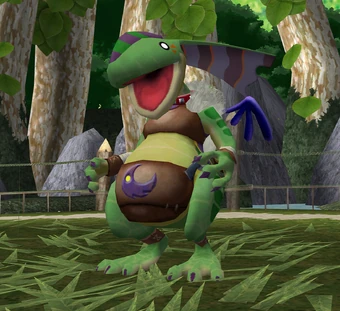
Something that I do really love about this game is its art design. Sure, there’s cues from some of their previous games, but the cutesy style really reminds me of the early Pokémon games as well, with some of the bosses looking like they could feasibly be forgotten Pokémon designs. I love how colourful and vibrant the world is as well, with some cool spins on classic level themes, like a pirate-themed take on a beach level and throwing dinosaur fossils into the volcano stage. Whenever I got annoyed with the game, I couldn’t stay mad at it for too long because I think the visual style really helps it stand out.

Era Gecko | Billy Hatcher and the Giant Egg Wiki | Fandom

A couple of extras come attached to this game too, though I never got to experiment with them. There are a few GBA tie-in games you can unlock by hatching certain eggs which is cool, but I don’t have the GBA connection cable. There’s also a multiplayer mode, which was a Sonic Team staple for a while. I miss the days where games had all of this bonus content that they didn’t need to include just to enhance the overall experience.

Overall, I think Billy Hatcher is a flawed game with heaps of potential. The early part of the game is really fun and an absolute blast, but the latter half gets needlessly difficult due to issues that really shouldn’t cause as much trouble as they do. I’d love to see Sonic Team revisit this world and make a sequel, but 17 years on it seems unlikely, as there’s much less demand for this than say a Pokémon Snap sequel which we got after an even longer wait. Sonic Team should definitely go back to experimenting with making different games though, even if not everything works it’s always fun to see what they try. At least include Billy in the next SEGA crossover, for goodness sake.

Pokémon Snap: A Picture-perfect Spin-off

Nintendo 64 Longplay: Pokémon Snap - YouTube
FUN FACT: Pokémon Snap wasn’t originally planned to be a Pokémon game, but something called Jack and the Beanstalk, much like the fairy tale.

Early Pokémon spin-offs were strange, they built on the concept of capturing every Pokémon in unique ways. Snap is one of the most fondly remembered spin-offs, and sees you capturing Pokémon not in Poké Balls, but with a camera. New Pokémon Snap has just been announced, so I figured it’d be nice to talk about the game that’s waited 21 years for a sequel.

In terms of gameplay, Snap is incredibly simple. It’s basically an on-rails shooter, only you use a camera instead of a gun in one of Nintendo’s signature spins on an established genre. You’re trying to get the best pictures of the wild Pokémon as possible, in order to do Professor Oak’s work for him (no changes there then). What’s most surprising about this simple gameplay is just how good it feels.

The main USP of Snap at the time it was released was seeing Pokémon in their natural environments, something that still has appeal to this day (hence the sequel). In addition to just watching them you can throw apples or Pester Balls at them to change how they’d react, or to prompt specific events, even evolutions in some cases. However, this did mean that cuts had to take place, as animating 151 Pokémon would have been incredibly time consuming. Consequently, this number was slashed to 63. Others like Ekans were planned in the beta, but unfortunately never made the cut.

The available Pokémon are divided into 6 areas, with a hidden seventh one housing Mew. With only a few Pokémon in each, the game isn’t that long, but honestly that doesn’t diminish any enjoyment at all. To this day it’s an incredibly fun time, seeing all the Pokémon going about their lives as you take pictures of them. There’s something oddly peaceful about it, except for when you’re trying to get a rare Pokémon to appear, or evolving one. Then it’s a bit more stressful.

Even though it was a Nintendo 64 game, I have to say that I really like how the game looks. Sure, it hasn’t aged the best, but it looks nice for what it is and the animations are so charming that you don’t find yourself focused on the individual polygons and textures. The game just oozes charm and charisma. You also have to give it props for bringing the 8-bit sprites from the Game Boy games to life in such an artful way.

I feel that this game was perfect for some kind of multiplayer action, like pitting two players against each other to see who could take pictures of more unique species. Heck, there’s even a points system in place, that could be easily translated to a multiplayer system. That could really add to the replayability, so it’d be nice to see them add something similar to the new entry, as unlikely as it may be. Even without this though, the game is still very replayable as is, I’ve gone back to it a few times myself.

In a way, Pokémon Snap feels like going on a safari drive in the Pokémon world, and it really succeeds at that. This game brings about a certain type of magic that a lot of other Pokémon spin-offs can’t quite reach, and I feel like that’s why it’s remained such a popular game over two decades after its release. Hopefully, New Pokémon Snap can do the original justice, and based on the release trailer that came out last week, I’m optimistic.

The Messenger: A New Spin on Old

The Messenger | Nintendo Switch download software | Games | Nintendo
FUN FACT: Interacting with The Shopkeeper’s cabinet multiple times makes him go on a long rant at you.

Quarantine is surely getting to everyone right about now, and one way to fend off the blues when you’re not playing Animal Crossing is to play something else. For me, that’s been The Messenger.

Retro-inspired games aren’t a new concept, but it’s safe to say that The Messenger is a solid addition to games of that calibre. What starts out as looking very much like a Ninja Gaiden wannabe soon takes a life of its own. In the end, I forgot I ever compared the two.

Where The Messenger shines is that it’s a love letter to old games. What starts off as your standard 2D 8-bit adventure transforms as time goes on, and there’s secret levels and much more to keep an eye on. Even the genre of the game changes about a third of the way through into more of a Metroidvania, and it’s a bloody enjoyable one nonetheless. There’s the aforementioned homages to Ninja Gaiden, but the room-based level design has Mega man vibes as well. Then there’s extra nods that I won’t delve into because they have to be seen to be believed.

Now a staple of 2D platformers – Metroidvania or otherwise – are the secret collectables. The Messenger has Power Seals, and as you’d expect they’re dotted around the various worlds you explore. Unlike Mario’s Star Coins, however, most of these aren’t hidden in plain sight, meaning you have to try and find secret entrances to bonus rooms, often by destroying rubble on the sides of the map. These rooms have a series of challenges (some of which are really difficult), but your effort will be rewarded with a Power Seal if you persevere. Compared to a lot of games with similar collectables, Power Seal challenges are challenging but fair. And I should know, I was able to get them all (albeit with the help of the map, which ends up pointing out where they are). The reward’s pretty good too, so I’d definitely recommend it.

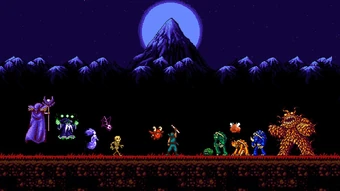
My main criticism with the game comes from the lack of enemy diversity. From the first stage to the last, there’s only around 24 enemies, most of which are limited to a level or two. What I will say though is that the level design caters very well to these enemies, creating some puzzles where you have to consider their patterns carefully before deciding to move. In essence, they’re sometimes just as much standard platforming obstacles as moving platforms and spike pendulums. I feel like that makes the repetitiveness less painful.

Enemies | The Messenger Wiki | Fandom
You’ll be seeing some of these guys quite often, that’s for sure.

New Game+ in The Messenger is no joke either. Not only do you get your standard more difficult playthrough, but every consecutive one stacks, with each being harder than the last. Getting a game over, which honestly seems quite easy, throws you back to the first New Game+ setting. It’s tough, really tough, but you know what you’re getting yourself into.

What I will say is I was lucky enough to get it free (there was an offer a while back that I used), I got 17 hours of playtime out of it, and I’ve not yet touched the free DLC, which i only found out existed as I was doing research for this article; I thought the in-game references to it were a joke, which given the dialogue in this game, wouldn’t be shocking. In fact, the dialogue might be my favourite thing about it; excluding certain story moments, the game doesn’t take itself seriously, and The Shopkeeper is an absolute delight of a character from pretty much the moment you meet him (which is quite early on).

In these crazy times, it’s important to stay indoors and keep yourself safe. Games like The Messenger are a great way to kill time and break up your day. And if I can 100% it, anyone can. If it’s the type of game you’re normally into, I’d absolutely give it a go.

Super Mario Galaxy 2: The Best Expansion Pass

Image result for super mario galaxy 2
FUN FACT: In early stages of development, the game was initially called Super Mario Galaxy 1.5 and was more clearly an expansion of the first game.

DLC isn’t unusual in today’s gaming industry. In fact, most companies have their games shipped off with the intention of adding more content at a later date, sometimes free but usually paid. How did this work for the Wii, a console that didn’t download updates for software? Make a new game of course. And that’s just what happened with Super Mario Galaxy 2, one of my favourite main series Mario games.

Gameplay-wise, most of the basics are taken directly from its predecessor. You’re in space and running around little planetoids. Mario moves the same as he did in the previous game, with the long jump, triple jump and spin jump as you’d expect from a Galaxy sequel. However, there’s lots of new content too. Yoshi makes his return, this time with access to some power-ups of his own. Mario also has some new tools, including the Rock Mushroom and Cloud Flower, both of which are great additions, even if controlling Rock Mario can be a nightmare sometimes. Unlike the first game, you eventually unlock the ability to tag out and play as Luigi whenever you’d like, so obviously we switched to the superior brother as soon as it was possible.

I just recently 100% completed this game for the first time, though I’d attempted to (and failed) years earlier. Having a second player was a godsend, because the P2 Luma can freeze enemies, defeat some of them and collect certain items like Coins and 1-Up Mushrooms for you. We also alternated every now and then, so sometimes I’d be P2 and try my best to stop all the hazards for P1. This definitely makes the game easier, but you can also screw up and hurt the plumbers inadvertently. Or intentionally, if you’re evil. My favourite feature of the P2 Luma is its ability to tickle NPCs though. There’s so many great animations you can find that give the characters more life.

Image result for super mario galaxy 2 tickle lubba
The amount of times we tickled Lubba throughout the playthrough was insane. His animation is adorable and warmed our hearts whenever a level had stressed us out. Get him in Mario Kart.

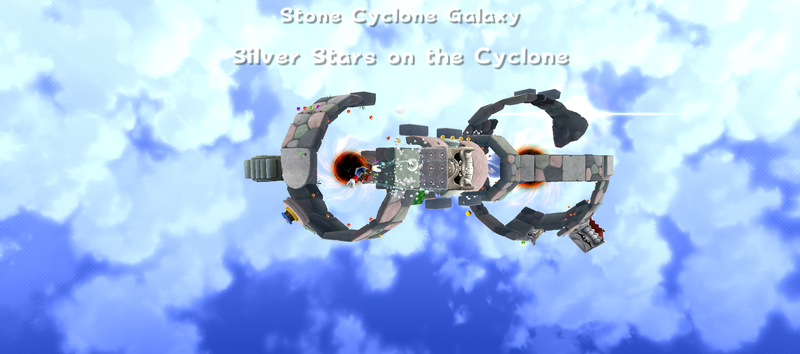
What’s surprising about this game though is just how difficult it can be when it wants to. Some of the later worlds have really tough challenges that test your skill with some gauntlets so challenging you wouldn’t expect them from a Mario game. Bowser Jr in particular has some tough levels at the ends of worlds, though the odd level can also have a secret Star that really puts you to the test. Combine that with Prankster Comets and there’s a perfect storm of challenge and fun. And then there’s Green Stars. I both love and hate the Green Stars. There is one level that had me ready to rip my hair out when collecting one of its Green Stars; shout-out to Stone Cyclone Galaxy’s first Green Star, by God was that a nightmare.

As you’d expect though, Galaxy 2 is a fantastic game, which is again just what the Mario franchise delivers time after time. It’s got its moments that infuriate you, like Stone Cyclone Galaxy and those nightmarish “break all the boxes” challenges (though P2 Luma helps with them as well), but it also has some of the most fun levels in a Mario game. Cloud Mario’s levels in particular are a favourite of mine, and I’m also a big fan of Bee Mario’s stages. Some of the Yoshi ones are great as well. All three have their fair share of annoying Green Stars though. Still, even when you’re angry about getting a Green Star, it’s fun. You know you can get it if you jump a little higher, and you’ve really got to think carefully in some cases (looking at you, Puzzle Plank Galaxy’s first Green Star). Grandmaster Galaxy is on another level of challenging when you have to complete a Daredevil (1-hit only) run, and my friend did that for us whilst I went out for a walk. Do I want to try it to redeem myself? Not on your life.

There’s also a lot of callbacks to older Mario games, which is sometihng this franchise does in a way that’s not too obnoxious compared to say Sonic’s love of Green Hill Zone or Pokémon’s obsession with Kanto and Charizard. Lots of different games get callbacks, there’s a balance. Of course the first game gets more obvious ones with its music returning (basically a staple of any Mario game at this point), though some tracks also come from Super Mario World. Supermassive Galaxy is adorned with the Brick Blocks, ? Blocks and Pipes we all associate with Mario now, and could be seen as a reference to Giant Land from Super Mario 3. Throwback Galaxy is literally just Thwomp’s Fortress from 64, and bosses from the first game (including the dastardly Bouldergeist) return for Boss Blitz Galaxy in World S. Stone Cyclone Galaxy is also taken from the previous game, but sped up four times out of spite. There’s probably countless more I’ve missed out, but these are the ones that called out to me.

File:SMG2 Stone Cyclone.png
Mario doesn’t know what he’s gotten himself into. Pain, pure pain. That’s what.

Galaxy 1 was a fantastic game, and all things considered I think 2 is a worthy, maybe even better sequel. Whilst I miss the Comet Observatory and Rosalina, Lubba’s great and there is so much to do. 242 Stars is nothing to scoff at. I’d not played it in around 10 years until this month, but we were so enthralled we were able to complete it in a week, and when a game keeps you that hooked you know it’s a brilliant one.

The Sonic Movie: A Fast Blast from the Past!

Image result for sonic movie
FUN FACT: Music used for one of the earlier scenes in the film, when Sonic is racing around Green Hill Zone, is reused from Sonic Mania – “Friends” by Hyper Potions.

When I saw the first trailer for Sonic the Hedgehog (the movie, not the game, and not the… other game we don’t want to speak of), I was sceptical, to say the least. Sonic didn’t look like Sonic, his friends were nowhere to be seen and there were humans all over the place. It looked like a worse version of Sonic X. When I watched it, however, every expectation I had was blown out of the water.

Sure, the storyline is another of the generic “guy meets magical/weird animal of some kind”, but it does it well. Everyone’s likeable, there’s some chemistry between Sonic and Tom, his human friend, and it’s an all round enjoyable film. My friend who was watching it with me said I had a massive grin on my face every time she looked over at me, and if a film’s capable of doing that then it’s a good one in my books.

Sonic’s character in this film is a bit different to his usual self. Granted, he’s still quite cocky and lively, but he’s also shown as a bit of a lonely oddball and a geek, which isn’t necessarily what people think of when they hear Sonic the Hedgehog. He’s normally an embodiment of ’90s edginess, or at least in a marketable form. Still, the new take on his personality makes him an enjoyable character that’s easy to sympathise with, potentially more than his usual cocky self might have been. Let’s hope that we see him morph into someone more resembling his game self in the sequel (because there will be a sequel).

Sonic’s adorable in this film, maybe not as cool as he used to be, but he’s still an engaging character.

Obviously, the film takes a comedic route, almost reflecting the emphasis on ‘humour’ that some of the more recent games have had. Unlike those games, the jokes for the most part are decent in the film, especially the bits involving Jim Carrey’s rather different take on Eggman. He chewed up the scenery every time he was on screen, it was a mesmerising performance that might not have had as much screen time as some of his older roles, but it was a delight to see. He plays a good villain, let me say that much.

There were some interesting scenes in the film that have definitely brought up the ideas of sequels, as I mentioned earlier. Sonic’s ‘origin story’ has him being hunted by some kind of villains. However, as briefly as they appeared, I was quite sure that they were the echidna tribe from Sonic Adventure, which potentially could tie into Knuckles being introduced in some way (possibly as a villain at first, like in Sonic 3). Likewise, a post-credit scene features something that made me audibly gasp whilst also basically confirming a sequel. And of course, there was that ominous shot of Eggman looking much more like his game counterpart, as well as a little scene showing he’s going even more insane than he already was. I’m sure we’ve not seen the last of Dr Robotnik just yet.

Image result for sonic movie echidnas
The creatures chasing Sonic definitely looked like one of these echidnas. Knuckles has to be there somewhere.

Something else about this film stuck out to me, and it was that Sonic is obviously famous for running fast and getting into all sorts of crazy hijinks. That made it a no-brainer for me to go and see it in 4DX. I’m not usually big on rollercoasters because of my fears of height and going fast, but when you’re just sitting on a vibrating chair in a cinema, you don’t need to worry about those things. And seeing it in 4DX was really like being on a virtual rollercoaster, from the shaking of the seat to the little gusts of wind whenever bullets were shot (Eggman’s robots love shooting bullets, so it happens a lot), it made the whole thing feel more alive. As someone who wasn’t too keen on the idea of 4DX at first, I’m glad I took the risk. As someone with glasses I was over the moon when I found out 4DX showings can be in 2D as well, that saved a lot of trouble.

So overall, I was really pleasantly surprised by Sonic’s live action cinematic debut (his animated film was pretty cool as well, I’d recommend it). As a fan of the series I’m hoping new people will be introduced to the franchise and it’ll breathe some new life into it, because if the box office and critical performance is anything to go by I think they’d be stupid to not make another one. It’s a really heartwarming film at times when it’s not full of fast-paced action, and if you’ve not seen it yet (though I’ve

Mario Party 8: Great With Mates!

FUN FACT: In addition to the regular characters, Mario Party 8 made some enemies (Blooper and Hammer Bro.) playable for the first time!

Mario Party, like Mario Kart, is a staple of games nights and has been for years. People gather round the TV to see who can collect the most Stars and Coins, competing in minigames to help pocket some extra cash to spend on Stars. Sounds great, right? In theory, yes. In actuality, this game – more than Mario Kart, I’d say – is where people’s dark sides come out. Competitiveness and the ability to screw each other over makes Mario Party a wild ride, and 8 was the first instalment of the franchise to appear on the Nintendo Wii.

Technically, I’ve never owned Mario Party 8. I’ve only played other people’s copies, my cousins’ one or one of my friend’s, to be precise. That doesn’t change just how strong my memories of this game are, and the amount of joy it’s given me over the years. It holds up for that alone, and that’s ignoring everything else that makes the game as fun as it is; a zany cast of characters, boards that are as creative as they are infuriating, and minigames that can make you feel like you’re on top of the world or an ant waiting to be crushed, depending on your performance.

Why this Mario Party in particular? Well, there’s the nostalgic factor, and the fact that (other than Super Mario Party) it’s the one I’ve played the most as a multiplayer game (I played a lot of single player Mario Party DS, thank you Kamek’s Library for that). And there’s also the fact that pretty much every game of Mario Party 8 I’ve ever played has been an emotional rollercoaster, to put it lightly. One of my favourite gaming stories comes from this game, in fact.

Last year, I went to a friend’s flat to play Mario Party 8. It started off as normal, with all the trash talking you’d expect, only for me and my teammate to manage an early lead. Obviously we got cocky and amped up our trash talking, but then we had 2 Stars stolen from us, meaning we had 1 and they had 3 or 4. We spent the last couple of turns catching up to them until we both had 5 Stars, though they had more coins then us. Then came the Bonus Stars. We got one, and so did they. Thinking two Bonus Stars was the norm (it never has been, I’m just a fool), I’d resigned myself to defeat for what must have been the third or fourth time this game. And then, with all the grace you could imagine, a final Bonus Star descended onto the screen. It was the Red Star, essentially for being the most unlucky. And you’d better believe we won. I literally jumped out of my seat and screamed, that’s a memory that is burned into my mind and I have Mario Party 8 to thank for that.

Online I’ve seen a lot of whispers saying they believe 8 is one of the weaker entries in the franchise. I’ve not played enough of the games to be able to say anything for sure, but if 8 really is one of the weaker ones, then holy hell the others must be fantastic games. Par for the course for Mario, I suppose, but still. My only gripes really had to do with motion controls, but that’s a problem that plagued the Wii era so much that you can’t really use it as a criticism for a game if it wasn’t excessive. At least there weren’t any joystick spinning minigames like in the first Mario Party. I’ll take tired arms over bleeding palms any day of the week.

I do think that, in retrospect, there’s things that newer entries could take from Mario Party 8. In particular, I’m making comparisons to Super Mario Party, the newest game in the franchise (and a bloody great one at that). Bigger board sizes would be cool, bringing the dice rolls back to 10 (even if it’s nonsensical that a 6-sided dice goes up to 10), bringing back Blooper as a playable character, and ultimately I’d say the main one is bringing the total number of boards back up to 6, or at the very least 5. Variety is the spice of life, after all, and Mario Party 8 certainly has that. Even if 6 isn’t the biggest number of boards, so much is different between each playthrough that it’s a game you can go back to over and over. Never stop the Mario Party (8).